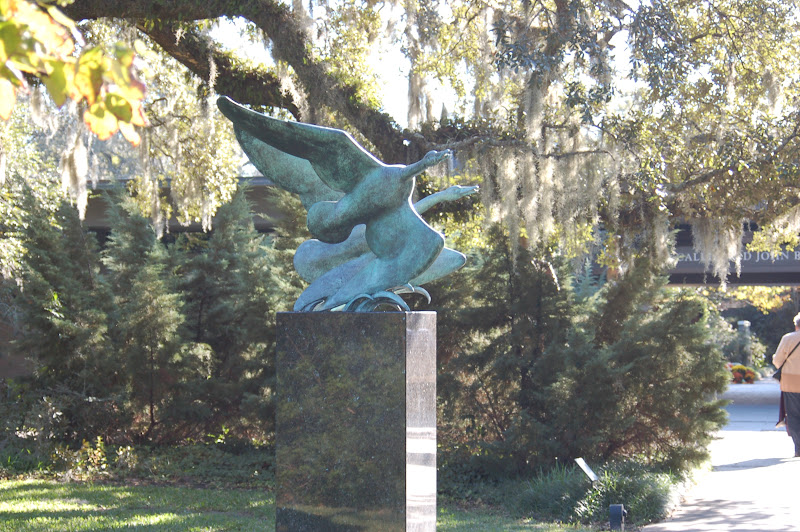
The first thing I need to say very emphatically - especially after looking at the photos we took while walking

around - is that it is clearly impossible to capture the magnificence of Charleston in photographs or in words alone. A combination of the two helps but there is just no substitute for actually being there. But, even if your visit has to be vicarious, please, please take whatever opportunity you have to get to know this

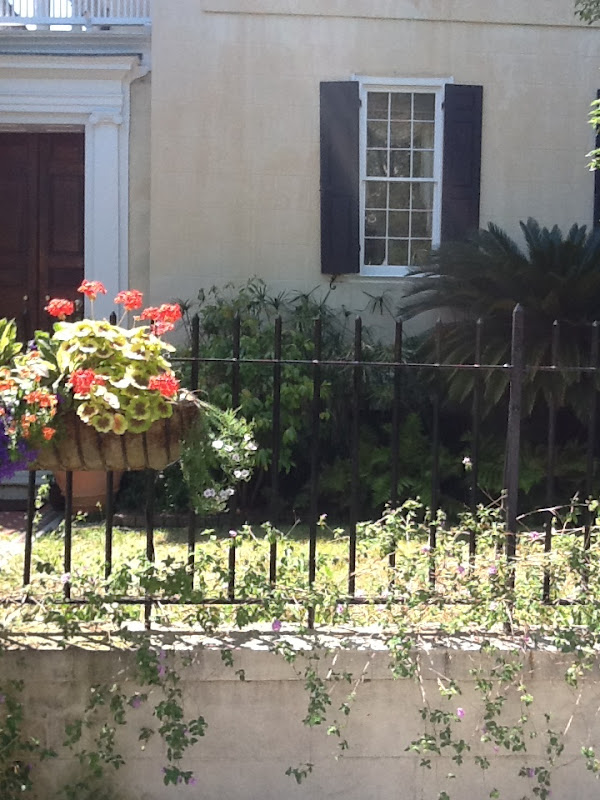
national treasure. The beauty of the homes, the hidden gardens and the charming fountains are all amazing but you have to see some of the subtle, almost invisible details and read the history of these structures to gain an appreciation of the city and all it has seen. Take the picture on the left for example. This is a home on the western end of the battery and is not one of the older buildings. At first glance it might even seem ordinary. But take a closer look at the details in the windows and in the trim above the windows. These artistic yet understated features are found everywhere. In the most majestic structures facing Battery Park (often referred to as "Battery Row") and tucked away in tiny alleywa

ys that lead to unbelievably beautiful plazas. And, the ironwork that abounds in the neighborhoods is as much a part of the pride of the city as the homes themselves. Some of the most artful works are the creation of local craftsman

Phillip Simmons whose ironwork is recognized and treasured throughout the world. The huge mansions that look out over the harbor represent an incredible range of architecture and while I'm not an expert on the styles, they are described as "Georgia, Federal, Adamesque, Greek Revival, Italianate and Victoria". Further north - along the streets that run perpendicular to the Battery - the houses, while still remarkably varied, generally fall into two categories referred to as 'single' and 'double' houses. Single houses are one room wide and are built 'sideways' to the street with deep, covered, multi-story porches or piazzas along

one side. The design allowed breezes from the prevailing winds to flow from one end of the house to the other while the porches served to shade the windows from the sun. The 'double' houses are two rooms wide with their full length facing the street. While some have lengthy porches, others have a more subdued entryway. Both styles of homes

nearly always have a beautiful garden area along the front (or side) of the house and the flowers, shrubs, hedges, trees, fountains and walkways are stunning. Along parallel streets such as East Bay Street and Meeting Street colorful, stuccoed townhouses are joined together over lengthy stretches but each retains its individuality with its own pastel

painting. This area known as Rainbow Row is one of the most photographed and painted areas in the city. Other, smaller clusters of townhouses represent some of the very early efforts at "urban renewal." While the tornadoes, earthquakes and fires that have damaged or destroyed larges sections from time to time, Charlestonians themselves are committed to maintaining the beauty of the city and since the 1800s have periodically undertaken restoration projects. In fact one of my favorite
 |
| Site of city's oldest recorded deed |
streets, Queen Street" originally had the name "Dock Street" but was re-named when the area became popular as a site for converting existing buildings into town homes. The beautiful pink building on the right is where one of my favorite uncles lived until shortly before his recent death. While several of our folks still have property in the area this will likely be the last "downtown" residence in the family. It is a lengthy structure with a
 |
| C. Pinkney - Founding Father |
beautiful garden at the rear surrounding the windows of the dining room. Watching over the renovation of buildings in the city is the "Charleston Historic Preservation Society", the highly influential
 |
| William Bull home - built 1720 |
organization without whose approval very little construction can be done. The Society also ensures that the provenance of each building is properly documented and often places plaques explaining the history of both structures and residents. The plaques seen here were placed by different organizations. The one to the left an extraordinarily rare sight because the sign placed by the Historical Preservation Society is in disrepair. It shows, by the way, the home of former Lt. Governor of the Colony, William Bull. The property was granted to his father, a resident of the area near Beaufort known as Sheldon, in 1696. (If you ever get a chance, visit the "Old Sheldon Church" cemetery

where many of the original members of the family are buried. It is amazing!!) It was at this site that Governor Robert Hayne persuaded a group of hostile secessionists not to attack a Union ship. His action postponed but, unfortunately, did not eliminate the threat of secession. It is amazing to look at these plaques and realize that the people who lived here participated in some of the most significant events in the history of the U.S. Charles Pinkney, signer of the Declaration of Independence and President of the Provisional Congress, Thomas Gadsen, son of Revolutionary War General Christopher Gadsen,

General P. T.G. Bueauregard who led the capture of Fort Sumter, Dr. Vincent Le Seigneur who established a hospital for slaves on fashionable Broad Street right in the center of Charleston, and so many, many more. The town breathes history!!!! In fact, some of the current residents display the colors that have flown over the city at one time or another and demonstrate that the past is not always so distant as we might

think. (A bit of trivia for you!! In the photo to the left there are four flags. On the far left is the "Don't Tread On Me" flag designed by Christopher Gadsden. [First flag carried by U.S. Marines into battle.] On the far right is the official flag of the Confederacy. The red flag with the palmetto tree is the "Spirit Flag" of the Citadel and the other one ... blue with "Liberty" on the bottom is not a South Carolina flag at all. Although patterned after the 2nd regiment flag, the one shown is actually the ... "official flag of Moultrie County Illinois!!!!!!" Oops ...) Other front porch decorations are less political and much more colorful. Whatever their nature, the decorations of these homes reflect the owners' pride in their residences but also their regard for those who visit them or their city. Everywhere you turn there is something else that takes your breath away or strikes a resonant chord deep in your soul. Clearly, those who built these beautiful places, those who ensure that they remain places of which the city can be proud

and those who come here year after year to enjoy them share a profound love for our country, our state and our history. I think I've made it pretty clear over the time you've been hanging out with us how much we love our native state and how strongly we believe that it is a treasure that belongs to all the people of our country. There are things here that are almost unbelievable in their unique nature

and things that you would never have imagined existed in little South Carolina. We could continue looking at these beautiful structures for days and days but we've got a ton of other stuff to show you that I think you will find amazing. In fact, there is so much that we will break it down into several different categories. We will next visit some of the remarkable, historic and magnificent churches that led to the nickname "The Holy City". While we're downtown we will come back and look at buildings that currently or formerly housed some of the most historic government and civic organizations in our country. Before we end our visit we will pack up for a quick trip out to Fort Moultrie which actively protected Charleston and our country for over two hundred years. I hope you will come and join us for these delightful visits. You'll see some beautiful and moving stuff. See ya.
 around - is that it is clearly impossible to capture the magnificence of Charleston in photographs or in words alone. A combination of the two helps but there is just no substitute for actually being there. But, even if your visit has to be vicarious, please, please take whatever opportunity you have to get to know this
  national treasure. The beauty of the homes, the hidden gardens and the charming fountains are all amazing but you have to see some of the subtle, almost invisible details and read the history of these structures to gain an appreciation of the city and all it has seen. Take the picture on the left for example. This is a home on the western end of the battery and is not one of the older buildings. At first glance it might even seem ordinary. But take a closer look at the details in the windows and in the trim above the windows. These artistic yet understated features are found everywhere. In the most majestic structures facing Battery Park (often referred to as "Battery Row") and tucked away in tiny alleywa
 ys that lead to unbelievably beautiful plazas. And, the ironwork that abounds in the neighborhoods is as much a part of the pride of the city as the homes themselves. Some of the most artful works are the creation of local craftsman
  Phillip Simmons whose ironwork is recognized and treasured throughout the world. The huge mansions that look out over the harbor represent an incredible range of architecture and while I'm not an expert on the styles, they are described as "Georgia, Federal, Adamesque, Greek Revival, Italianate and Victoria". Further north - along the streets that run perpendicular to the Battery - the houses, while still remarkably varied, generally fall into two categories referred to as 'single' and 'double' houses. Single houses are one room wide and are built 'sideways' to the street with deep, covered, multi-story porches or piazzas along
 one side. The design allowed breezes from the prevailing winds to flow from one end of the house to the other while the porches served to shade the windows from the sun. The 'double' houses are two rooms wide with their full length facing the street. While some have lengthy porches, others have a more subdued entryway. Both styles of homes
  nearly always have a beautiful garden area along the front (or side) of the house and the flowers, shrubs, hedges, trees, fountains and walkways are stunning. Along parallel streets such as East Bay Street and Meeting Street colorful, stuccoed townhouses are joined together over lengthy stretches but each retains its individuality with its own pastel
 painting. This area known as Rainbow Row is one of the most photographed and painted areas in the city. Other, smaller clusters of townhouses represent some of the very early efforts at "urban renewal." While the tornadoes, earthquakes and fires that have damaged or destroyed larges sections from time to time, Charlestonians themselves are committed to maintaining the beauty of the city and since the 1800s have periodically undertaken restoration projects. In fact one of my favorite


 where many of the original members of the family are buried. It is amazing!!) It was at this site that Governor Robert Hayne persuaded a group of hostile secessionists not to attack a Union ship. His action postponed but, unfortunately, did not eliminate the threat of secession. It is amazing to look at these plaques and realize that the people who lived here participated in some of the most significant events in the history of the U.S. Charles Pinkney, signer of the Declaration of Independence and President of the Provisional Congress, Thomas Gadsen, son of Revolutionary War General Christopher Gadsen,
  General P. T.G. Bueauregard who led the capture of Fort Sumter, Dr. Vincent Le Seigneur who established a hospital for slaves on fashionable Broad Street right in the center of Charleston, and so many, many more. The town breathes history!!!! In fact, some of the current residents display the colors that have flown over the city at one time or another and demonstrate that the past is not always so distant as we might
  think. (A bit of trivia for you!! In the photo to the left there are four flags. On the far left is the "Don't Tread On Me" flag designed by Christopher Gadsden. [First flag carried by U.S. Marines into battle.] On the far right is the official flag of the Confederacy. The red flag with the palmetto tree is the "Spirit Flag" of the Citadel and the other one ... blue with "Liberty" on the bottom is not a South Carolina flag at all. Although patterned after the 2nd regiment flag, the one shown is actually the ... "official flag of Moultrie County Illinois!!!!!!" Oops ...) Other front porch decorations are less political and much more colorful. Whatever their nature, the decorations of these homes reflect the owners' pride in their residences but also their regard for those who visit them or their city. Everywhere you turn there is something else that takes your breath away or strikes a resonant chord deep in your soul. Clearly, those who built these beautiful places, those who ensure that they remain places of which the city can be proud
  and those who come here year after year to enjoy them share a profound love for our country, our state and our history. I think I've made it pretty clear over the time you've been hanging out with us how much we love our native state and how strongly we believe that it is a treasure that belongs to all the people of our country. There are things here that are almost unbelievable in their unique nature
 and things that you would never have imagined existed in little South Carolina. We could continue looking at these beautiful structures for days and days but we've got a ton of other stuff to show you that I think you will find amazing. In fact, there is so much that we will break it down into several different categories. We will next visit some of the remarkable, historic and magnificent churches that led to the nickname "The Holy City". While we're downtown we will come back and look at buildings that currently or formerly housed some of the most historic government and civic organizations in our country. Before we end our visit we will pack up for a quick trip out to Fort Moultrie which actively protected Charleston and our country for over two hundred years. I hope you will come and join us for these delightful visits. You'll see some beautiful and moving stuff. See ya.